Boris Johnson AIM Summit | Global Leadership Insights & Middle East Challenges
Boris Johnson AIM Summit | Global Leadership Insights & Middle East Challenges
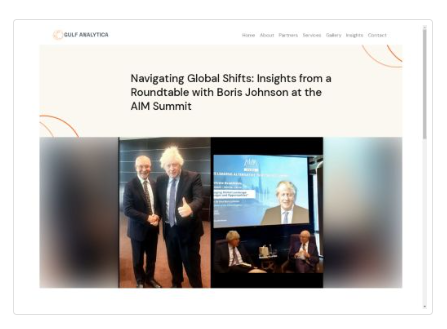
The global stage is witnessing an era of deep transformation, marked by geopolitical tensions, economic disruptions, and societal upheaval. Against this backdrop, the AIM Summit emerged as a timely platform for leaders, policymakers, and experts to explore strategic responses to global uncertainty. A highlight of this year’s summit was the engaging roundtable featuring Boris Johnson and David Gibson-Moore, which offered unparalleled perspectives on navigating global challenges.
The Boris Johnson AIM Summit session focused on understanding and addressing evolving threats and opportunities in international relations. In conversation with David Gibson-Moore, President of Gulf Analytica, Boris Johnson delved into topics such as leadership during crises, the geopolitical landscape, and the future of the Middle East.
Boris Johnson’s Global Leadership Insights
Boris Johnson, the former Prime Minister of the United Kingdom, brought to the AIM Summit his signature blend of wit, pragmatism, and strategic thinking. Drawing from his experiences leading the UK through Brexit and the COVID-19 pandemic, he offered global leadership insights that emphasized resilience, adaptability, and forward-looking governance.
During the Boris Johnson Global Shifts Roundtable Discussion, he pointed out that the pace of global change requires nations to evolve rapidly or risk irrelevance. Johnson stressed the importance of unity among Western democracies in facing rising authoritarianism, economic volatility, and technological disruption. According to him, the next decade will be pivotal in shaping global order, and leadership must be both visionary and grounded.
David Gibson-Moore’s Perspective on Global Shifts
Offering a complementary viewpoint, David Gibson-Moore’s perspective on global shifts was analytical and grounded in financial and geopolitical expertise. As a seasoned economist and strategist, Gibson-Moore addressed macroeconomic concerns such as inflation, sovereign debt, and the fragility of emerging markets. He warned of systemic risks tied to global debt cycles and declining trust in multilateral institutions.
His insights also extended to the Middle East, a region he described as being at a crossroads. According to David Gibson-Moore on the Middle East crisis, the region’s instability stems from economic inequality, youth unemployment, and insufficient institutional development. Yet, he also identified potential for transformation, especially if Gulf countries continue to invest in diversification, renewable energy, and innovation.
Boris Johnson and David Gibson-Moore Roundtable Discussion
The roundtable between Boris Johnson and David Gibson-Moore was not just a dialogue — it was a strategic exploration of how countries can future-proof their governance structures. Boris Johnson emphasized the role of “Global Britain” and argued for continued engagement in global affairs beyond the confines of European politics. His outlook reflects a belief in the UK as a connector between global institutions and regional powers.
Gibson-Moore added to this by outlining the Gulf region’s growing role in international finance, energy diplomacy, and conflict resolution. Together, their views offered a multi-dimensional approach to navigating international tensions, especially in complex regions like the Middle East.
Navigating Global Challenges with Boris Johnson
In discussing strategies for navigating global challenges, Boris Johnson highlighted the critical importance of multilateralism. He spoke about reimagining institutions like NATO and the G7 to reflect today’s realities, not those of the post-World War II era. He also emphasized leveraging economic partnerships and digital innovation to promote sustainable development.
Johnson’s strategic insight centered on reforming global systems to be more inclusive of emerging economies while maintaining core democratic values. He advocated for strong public-private partnerships to tackle global issues such as climate change, cyber threats, and pandemics.
Key Takeaways from Boris Johnson Roundtable
The key takeaways from the Boris Johnson roundtable include:
- The global order is in transition, requiring adaptable and principled leadership.
- Multilateral cooperation is more important than ever in facing shared challenges.
- The Middle East, while facing instability, holds significant potential for reform.
- Economic resilience must be built on diversification and sustainable policies.
- The next decade will define the political and economic architecture of the future.
These takeaways reflect Johnson’s pragmatic optimism and Gibson-Moore’s strategic realism, making the roundtable one of the most valuable segments of the AIM Summit.
David Gibson-Moore AIM Summit Leadership Insights
David Gibson-Moore AIM Summit leadership insights were shaped by his experience in the Gulf financial sector and his deep understanding of global capital flows. He stressed that leadership today means being financially literate, geopolitically aware, and ethically grounded.
His perspective illuminated the fact that while the Middle East faces challenges, it also possesses strategic assets: a young population, significant capital, and a willingness to embrace reform. He praised countries like the UAE and Saudi Arabia for taking steps toward economic diversification and global investment, seeing them as models for sustainable development.
Boris Johnson Insights on Global Shifts
The Boris Johnson insights on global shifts underlined the tension between nationalism and globalism. He warned against retreating into isolationist policies and stressed the necessity of open markets, academic exchange, and cross-border collaboration.
Johnson also discussed the importance of energy security, digital transformation, and investment in human capital. He urged leaders to think beyond short-term electoral cycles and make decisions that benefit future generations.
These insights shared at the boris-johnson-aim-summit demonstrated a clear understanding of the stakes involved and the complexity of the modern geopolitical environment.
Conclusion: Shaping the Future Through Strategic Leadership
The AIM Summit roundtable featuring Boris Johnson and David Gibson-Moore offered a rare convergence of political experience and economic strategy. Their discussions around global shifts, Middle East instability, and the future of leadership were not just informative but inspiring.
As the world continues to grapple with uncertainty, the insights from this session serve as a guiding framework for governments, businesses, and individuals seeking to navigate the road ahead. In an age where leadership is tested by global crises, the lessons from the Boris Johnson AIM Summit remain both timely and critical.
.jpg)
.jpg)

Comments
Post a Comment